A scarce Hogarth Press title
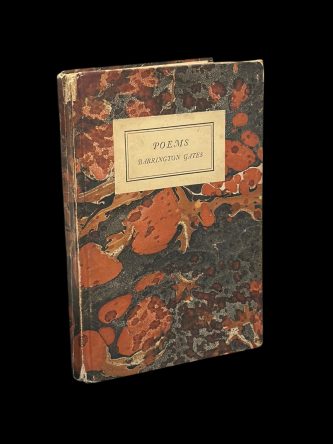
Gates, Barrington ~ Poems : Inscribed by the Author
The Hogarth Press, London : 1925 : Sole UK printing
The sole UK printing published by The Hogarth Press, London in 1925. 8vo., marbled paper-covered boards, with printed label to upper board; THE BOOKin Very Good- condition, though seldom found in any condition, here rubbed and bumped to the edges, sometimes with boards showing through beneath at the corners ; cracked along backstrip, with a partial 2cm chip to head of spine showing some webbing beneath; binding remains tight ; some light spotting to end-papers, and overall marginal toning, a clean example, internally. The book is protected in a removable Mylar archival sleeve. This copy warmly inscribed by the author in blue ink to the front free endpaper "So long as you don't ask me what these mean I don't mind, Barrington Gates, 15/6/41." Gates has written the recipient's name Z. Olenski, and underlined it to the upper edge of the page (the recipient has written the actual spelling of their name 'J. Olenski' beneath). A collection of poems by the scientist, artist, writer and critic Barrington Gates. Gates was born in 1893, and shortly after the death of his mother when he was just eleven years old, he moved with his father and siblings to Norwich, where he attended Higham Grammar School. Gates excelled in Mathematics, and he later wrote in his autobiography that the subject was "unique in its impact on the young. You either muddle along for a time with a lot of nonsensical ideas about how you are meant to use it, then give it up, or you suddenly see the light, after which you are alright, or at least as right as your intellectual capacity will allow” (Thomas and Küchemann 182). After receiving a scholarship to Corpus Christi college Cambridge, he began a degree in Maths, though he had always loved Literature and the Arts, and the pull between the two fields - 'Academic' and 'Artistic' was one with which he would struggle for his entire life. Highly inspired by the romantic and devotional poetry of such writers as Christina Rossetti, Robert Browning and William Blake, he began to amass a collection of books which undoubtedly influenced his later work. Graduating in 1914, he was recruited by the R.A.F., though he continued to write poetry, with some of his verses published in such magazines as the Windsor Magazine, The Westminster Gazette, and The New Witness. His first collection of poetry, Cargo, was published in 1918, influenced, like many were at the time, by the horrors of the First World War. The present work represents his second collection, and some of the poems went on to be republished in The London Mercury, The New Statesman, The Nation and the Athenaeum, The Westminster Gazette, The Poetry Review and The New Highway. 'Poems' takes as its theme the human condition and the influence of nature, and despite good sales, it represented the end of his career as a poet. He continued to work in the field of aerodynamics, and wrote sporadic articles of literary criticism for The Nation, The New Statesman, and the TLS. It is rare indeed to find any signed material by this author. "The number of copies printed not known but the Sussex ledger shows 60 copies sold by 19 January 1926." (Woolmer 62). Signed material by this author is very thin on the ground.
BINDING: Hardcover
CONDITION: Very Good-
£1250