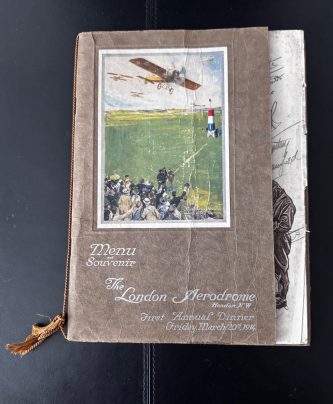
Grahame-White, Claude & Cuneo, Cyril (Illus.) ~ Menu and Souvenir ‘The London Aerodrome, Hendon NW : First Annual Dinner Friday, March 20th 1914’ : Unique Multi-Signed Booklet
Geo. Reynolds, Arts Printer, Stepney Green, London E : 1914
The sole UK printing published by Geo. Reynolds, Arts Printer, Stepney Green, London E in 1914. The BOOK is in Very Good++ condition. The original card stapled folder, with the original gold cord string marker present; The upper panel lettered in silver with the striking Cyrus Cuneo illustration 'Flying at Hendon' on white card attached to the centre. On the lower card cover another striking illustration in silver of the Hendon control tower and bi-plane; On the inside flap is a 'Toast List' dated March 20th 1914, the date of the dinner; pp 28 unpaginated; On the inside of the lower card is a full page coloured insert print ‘A Passenger Flight’ by Cyril Cuneo. On the rear flap are two inserts affixed, the first is the 'Menu' and on the reverse is the 'Musical Programme'. The front card has some creasing and minor rubbing to the illustration ; the first autographed page is spotted to the edges and has light markings ; the last page has some spotting ; the menu at the back of the folder has a closed tear but is complete ; there is also some closed tears to the rear insert print : Otherwise the booklet is complete. The now defunct London Aerodrome in Hendon was at the beginning of aviation in this country, where pioneers could hone their skills, train wannabe daredevils into trying to fly and set exams for people to take in order to be able to fly proficiently. It was at the epicentre of the early days of flying. So, with this, it attracted not just UK, but also Europe's best aviators and as the folder lists, they raced each other in front of the adoring public. The races drew large crowds as the small group of aviators pitted their wits against each other. This Menu & Souvenir booklet was issued to the great and good at a large function in Pall Mall at the Royal Automobile Club on 20th March 1914. Famous guests such as H.G. Wells and Ernest Shackleton were in attendance and within the booklet there was an ‘Autograph’ page at the front, so that the booklet owner could go autograph hunting for either famous people, politicians or as was prized, the aviators. Little did the guests in the Automobile Club know through all the merriment and award giving, that Europe was on the brink of war, and that in August of that year the lives of many in the room would change dramatically. Many of the aviators from Hendon Aerodrome would go on to fly for the Royal Flying Corp and rather than race, would be in aerial combat to the death. Of the owner of this menu, J.H. Blake, there is little known. However, he did amass 26 signatures from that evening, 11 are so far not identified, but 15 have been : 1) Claude Grahame-White : A pioneer and legend in UK aviation. He was only the 6th person to receive a certificate to be able to fly in this country and the first person ever to successfully make a journey at night, having done so during a London to Manchester race in 1910. He bought 200 acres of land and put his flying school on it, developing what was to become The London Aerodrome. He would encourage other pioneers to work from Hendon with their own flying schools too, making it a successful collaboration and a club. But it was Grahame-White that was the man in demand, and he would teach the likes of Emmerline and Christabel Pankhurst along with H.G. Wells how to fly. He made films about flying and wrote several books - he was in short a very early passionate leader in the field of aviation in this country. In August 1914, he would have to put his commercial enterprises on hold, at the worst moment, his aerial derby from Hendon was in that year, competing with the horse race of the same name for visitor numbers. But he went and served with the RFC, whilst Hendon was taken over by the Admiralty and then by the RAF, latterly becoming RAF Hendon, and that was that for Grahame-White. The site of the London Aerodrome is now called the Grahame estate. 2) Louis Arbon Strange : was one of the most decorated fighter pilots in the UK having served in both wars, flying and playing a pivotal role for the RFC and for the RAF. He received his pilots certificate only the year before the outbreak of the Great War and had just joined 'the upside down' club, being only a hand full of pilots at that stage to complete a loop. He joined 6 Squadron and completed many dare devil raiding missions, where he bombed enemy lines and targets. He was quickly promoted to the rank of captain, and at the Battle of Neuve Chappelle, he carried out one of the first tactical arial missions, dropping bombs on a heavily fortified railway station. He received the Military Cross from the King for his heroics. Strange was instrumental in the use of mounted machine guns on planes in his squadron. He would go on to create an air gunnery school for other squadrons to follow and, as a major he was given several squadrons to take on the Germans with. In total towards the back end of the war, he oversaw the destruction of over 440 enemy aircraft, impressive for someone in his 20's. For the RAF he played a key role in operation overlord and was responsible for ensuring a series of temporary staging posts. He became an officer of the order of the British Empire and received the American bronze star for his role in D-day. 3) Henry Pagan Lowe : was Claude Graham-White's test pilot at Hendon and then signed up to serve with the RFC in the great war. He was initially a despatch rider, then a mechanic and then due to casualties, was promoted to 2nd Lieutenant pilot in the flying corp. He soon displayed his gallantry and received the distinguished conduct medal for saving an unconscious pilot in a burning aircraft. He was killed in action whilst in service in France in 1916. 4) Eric Bentley Beauman : At the outbreak of the war he joined the Royal Navy Air Service, and was immediately told that he was the 'sole air defence of London'. He said of his role, that he wasn't armed and that ''fortunately no Zeppelin came over the city while I was defending it in this way.' He then served in antisubmarine patrols at home and in the Aegean as well as commanding seaplane stations at Dundee and Newhaven. In 1917 he was mentioned in dispatches. He would after the war, rise to rank of Wing Commander for the RAF. In the Second World War he was RAF liaison officer to the BBC. 5) Norman Spratt : Served in both wars - for the RFC and also for the RAF. He was a highly skilled pilot and for a period in 1914, at the time he signed this menu, he held several records including the world airspeed record and the British altitude record. Perhaps the most impressive of all feats was that he holds the honour of being the first aviator to win a dogfight in a war, as a few days after war was declared, he forced down a german plane in his Sopworth, made all the more remarkable as his plane wasn't armed. 6) Major Reginald Carr : He was one of the most decorated aviators before the Great War: he won the Michelin Cup, a prize given to the longest flight of the year (315 miles) and finished 2nd in the the national derby in 1914 around the time of the dinner. He would go on to fly in 3, 6 and 19 Squadrons for the RFC in the Great War. He flew with decorated Victoria Cross fighter pilot James McCudden in defence of shipping lanes and picking up supplies under fire. He received the distinguished conduct medal and is mentioned many times in McCuddens classic biography 'Flying Fury'. 7) Thomas Williams : was a decorated flying ace in the Great War made all the more incredible due to his age. He passed his flying exams in 1914 at 15 year of age. Then as a 17 year old in 1916, was in action, initially in West Africa but then as an 18 year old, he joined the RFC in France and was sent into arial combat in a Sopworth Camel. He achieved nine air victories and was awarded the Military Cross for gallantry. He then received the distinguished Flying Cross and in the Gazette, it said: "During recent operations this officer rendered most gallant and valuable service, proving himself to be a very capable and inspiring leader. On one occasion, observing three enemy railway trains, he dived, and in face of very heavy machine-gun fire seriously damaged one by a direct hit with a bomb. He then descended almost to the ground, and attacked the personnel escaping from the ruined train, scattering them in all directions. On returning to his aerodrome his machine was found to be riddled with bullets." By the end of the war, he was at the tender age of 19, a flight commander and was assigned to a British force in Russia, helping anti-Bolshevik forces. He took on many senior and high ranking roles during the second world war including commanding his own air base and leadership roles in bomber command. 8) Andre Marcel DeSoutter : Passed his flying test aged just 17 but in 1913 aged 18, he lost his leg in a flying accident at Hendon. A year later DeSoutter set up a company in the UK, manufacturing wooden legs. DeSoutter Tools then went on to manufacture other artificial limbs. He also managed to adapt an aircraft so he could fly again. Later in life he partnered with another aviation expert to establish an aerodrome in Gatwick and was still managing director of the airport up to his death in 1952. 9) Lord Lonsdale (Hugh Cecil Lowther the 5th Earl of Lonsdale) : He was a peer and member of the House of Lords. He was founding member of the 'sporting club' and donated the Lonsdale belts in boxing. He was also heavily involved in Horse Racing, and was part of a famous wager about circumnavigating the globe. 10) Sir Edward Hobart Seymour : Had a long and distinguished career in the Royal Navy and rose to the rank of Admiral. He was commander in chief at the China station during the boxer rebellion. He also served in the Crimean war, the Second Opium War and the Taiping Rebellion. 11) Sir Henry Capel Holden : was the chairman of the Automobile Club and chief instigator for the dinner taking place in Pall Mall. He has the accolade of being the designer of the famous Brooklands motor racing track and was the inventor of the first motor bike to be used in the UK, this being the Holden Motor Bicycle. Of the other signatures identified : 12) Jules Nardini : May 1912 also saw the arrival at Whitfield of Jules Nardini who was described as the “resident aviator". Nardini was already famous, having participated in many air competitions and exhibitions at Hendon, where he was particularly noted for giving flights to young ladies! He was Italian and had been living in France but was expelled for 'dubious' political activities, which seem to have revolved around his having alerted the Italian Government to the fact that the French were selling aeroplanes to the Turks. He arrived in exile at Whitfield after an unscheduled stop in Deal, on Lord Northbourne's estate, due to a defective compass. On the day following his arrival, he gave an exhibition of flying over Dover Harbour. Nardini was killed on his 13th Channel crossing. ( Dover’s Forgotten Aviation History : Brian Flood, Vice Chairman, Dover Transport Museum) 13) Lewis Turner 14) Marcus Manton : On the outbreak of war, Manton tried to join the RAF but was rejected on medical grounds. Instead he became an instructor at Hendon where he taught many RFC and RNAS officers to fly. 15) J. Laurence Hall : Founder of the Hall Flying School, at Hendon in 1914. Only one copy has appeared at auction in the last 30 years. JSIC has no listings. An important historical document and unique with such attributes.
BINDING: Hardcover
CONDITION: Very Good++
£1250