Inscribed in the year of publication
Talbot, Katherine [Barker, Ilse Pseud.] ~ The Innermost Cage : Signed By The Author
Faber and Faber Ltd, London: 1955
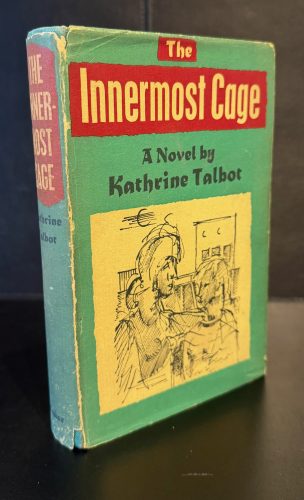
The First UK Printing published by Faber and Faber Ltd, London in 1955. 8vo., bright green cloth, spine lettered in gilt; in the publisher's printed wrapper (unclipped, '12s 6d net') featuring a pencil sketch by the author's husband, Kit Barker (unattributed); The BOOK Is in Very Good++ or better condition, just slightly toned along the spine, with minor rubbing to the edges of the cloth; ever-so-slight shelf lean, and a couple of tiny marks to the fore-edge, one or two within the page margins; The WRAPPER is in Very Good++ condition, being rubbed along folds with a little loss of colour; some small losses to the ends of folds and mostly at the spine tips, with no loss of lettering; spine and lower panel a touch toned; completely unrestored. The wrapper is protected in a removable Brodart archival cover. Inscribed in the year of publication to the front blank end-paper : "I want to inscribe this book to you, dear Elaine, with many thanks for all your help & your faith in 'The Innermost Cage.', Ilse, Bexley Hill, September 1955." Barker's second novel writing as Katherine Talbot. Born in 1921 to German-Jewish parents, Ilse Barker was sent to international school in Geneva, where she began to write poetry and the animated correspondence for which she would later become known. As tensions began to rise further in Europe she was sent to England, where she worked unpaid until the end of the war, and began to focus her writing on short story collections. It was in 1947 that she learned her parents had been murdered in Auschwitz and Terezin concentration camps. She moved to Cornwall and married the artist Kit Barker, and together they moved to America. 'The Innermost Cage' was published just a few years later. It was the first to use her adopted pseudonym, which the author chose voluntarily, believing her first name to be 'too foreign' and wanting a literary, artistic identity separate from her husband's. Semi-autobiographical, the story follows a successful novelist who suffers from a traumatic past, having been shipwrecked at sea as a child, and orphaned in the process. During her time in America, Barker also corresponded actively with the American poet Elizabeth Bishop - over 400 letters between them are now held at Princeton University. A book "Like the pinprick opening of a lens into the past", as she writes within. A scarce association copy.
BINDING: Hardcover
CONDITION: Very Good++
JACKET: Very Good++
£395