The first of Brecht's plays to appear in English
Brecht, Bertolt ~ A Penny For The Poor
First USA Printing : Hillman-Curl, Inc., New York : 1938
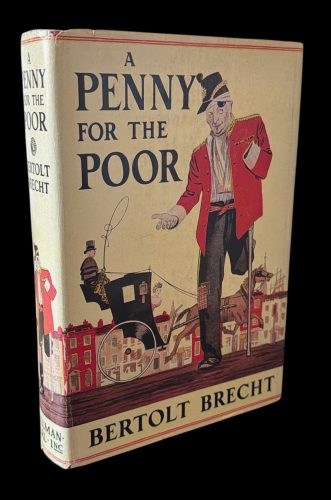
The First USA Printing published by Hillman-Curl, Inc., New York in 1938. The BOOK is in near Fine condition. 8vo., bright red publisher's cloth, lettered, lined and decorated with hand and arm devices in black to upper cover and spine; yellow top-stain remains bright., else untrimmed; together in the vibrant pictorial wrapper featuring a man with one leg to the upper panel and spine (unclipped, displaying the correct price of $2.50 to the front flap); An excellent, bright copy, with just a couple of tiny marks to the rear board; light offsetting and toning to the blank end-papers ; with a small shop sticker of Miller & Rhoads to the lower rear paste-down. The WRAPPER also in excellent Very Good++ or better condition, retaining much of its original colour with just a hint of sunning to the spine; light edge-wear to the spine tips and one small closed tear to the rear flap fold; aside from marginal shelf wear a very attractive example. The wrapper is protected in a removable Brodart archival cover. First USA printing, translated from the German by Desmond I. Vesey with the chapter-head verses translated by Christopher Isherwood. A novel, based on the author's famous 1928 musical play, 'A Threepenny Opera' (later re-issued as 'Threepenny Novel'), which he co-wrote with Kurt Weill, itself loosely based on John Gay's 'The Beggar's Opera'. The play was filtered through Brecht's experiences among the criminal fringe elements of the Weimar Republic. It was the first of Brecht's plays to appear in English. Bertolt Brecht was born in 1898 in Augsburg, Germany, and was 16 when the First World War broke out. Exploiting a loophole which allowed medical students to be deferred from the army, he enrolled at Munich University, and began to study theatre under the guidance of Arthur Kutscher. His first works of theatre criticism began to appear as early as 1919, and over the following few years he took part in a political cabaret of the Munich comedian Karl Valentin. Valentin became a huge influence for the young writer, and he wrote his first full-length play, Baal, in response to an argument he had with Kutscher during one of his drama seminars. This re-writing of other's work - as well as his own - would become a key theme in his writings. As he claimed, "Anyone can be creative...it's rewriting other people that's a challenge." Over the following years of the 1920s, Brecht began studying Marxism and Socialism in earnest. By the 1930s, he had formed a writing collective which was composed of such names as Elisabeth Hauptmann, Margarete Steffin and Ruth Berlau. Together, they adapted John Gay's 'The Beggar's Opera' into 'The Threepenny Opera', with Brecht's lyrics set to music by Kurt Weill. The resulting opera was a huge hit in Berlin, and helped to renew public interest in the musical genre worldwide. Set in Victorian London, the plot follows Macheath, the leader of a criminal gang, who marries Polly Peachum at the displeasure of her father. In revenge, he seeks out Macheath's death - but is hindered by the chief of police, Tiger Brown. ""You are about to hear an opera for beggars", Brecht famously narrates ahead of the performance, "Since this opera was intended to be as splendid as only beggars can imagine, and yet cheap enough for beggars to be able to watch, it is called the Threepenny Opera." Fearing persecution, Brecht fled Nazi Germany in February 1933, and after stints in Denmark and Finland, he settled in California to continue his career as a screenwriter. Very scarce with the wrapper in such bright condition.
BINDING: Hardcover
CONDITION: Near Fine
JACKET: Very Good ++
£1100